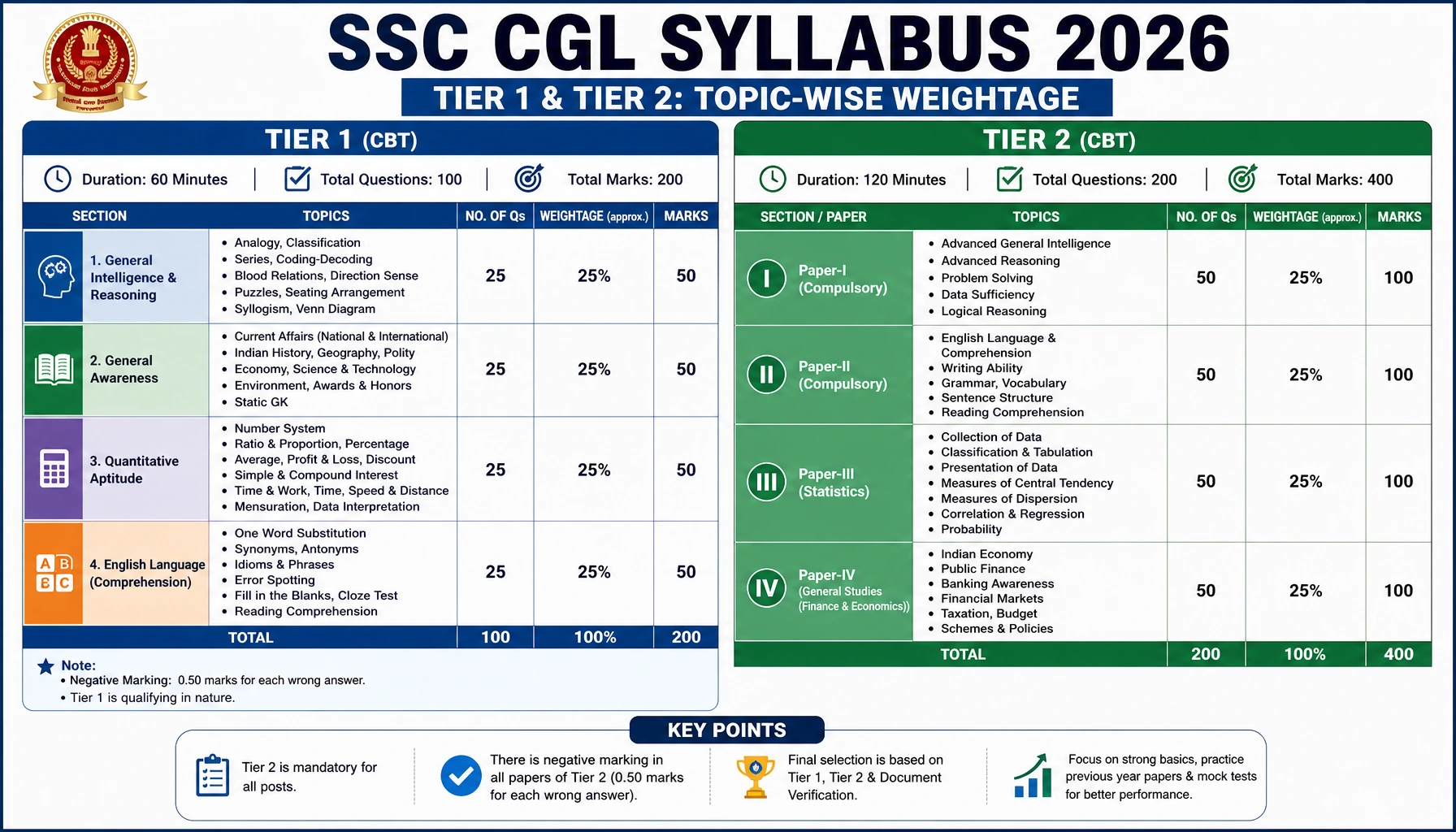
SSC CGL Syllabus 2026 for Tier 1 and Tier 2 is explained in detail on this page along with the latest exam pattern, topic-wise weightage and minimum qualifying marks. The Staff Selection Commission conducts the Combined Graduate Level exam in two phases, Tier 1 and Tier 2, and a clear understanding of the syllabus helps candidates build a focused study strategy. The SSC CGL Tier 1 exam consists of four sections, Quantitative Aptitude, General Intelligence and Reasoning, English Language and General Awareness, each with 25 questions, for a total of 100 questions and 200 marks to be completed in 60 minutes, with a deduction of 0.50 mark for each incorrect answer. Tier 1 is compulsory for all posts and qualifying in nature. The Tier 2 exam is conducted online in objective multiple-choice format, except the Data Entry Speed Test. Paper I is compulsory for all posts and covers Mathematical Abilities, Reasoning and General Intelligence, English Language and Comprehension, General Awareness, Computer Knowledge Test and Data Entry Speed Test, conducted in two sessions on the same day. Paper II on Statistics carries 100 questions for 200 marks in 2 hours and is meant for candidates applying for Junior Statistical Officer in the Ministry of Statistics and Programme Implementation. Tier 2 carries a negative marking of 1 mark for each wrong answer in both papers. Topic-wise weightage based on previous years shows reading comprehension, cloze test, coding-decoding, analogy, algebra, geometry, current affairs and general science as high-scoring areas. The minimum qualifying marks are 30 percent for UR, 25 percent for OBC and EWS, and 20 percent for SC, ST, PwD and others. The official syllabus PDF is available at ssc.gov.in. Keep following this page for SSC CGL admit card, answer key and result updates.
STAFF SELECTION COMMISSION
Combined Graduate Level Examination
Tier 1 & Tier 2 Syllabus 2026
SYLLABUS
SSC CGL 2026
TIER 1 & TIER 2
SSC CGL Syllabus 2026Last Updated: 26.09.2026
SSC CGL SYLLABUS 2026 FOR TIER 1 & TIER 2 EXAM
TOPIC-WISE WEIGHTAGE, EXAM PATTERN & SYLLABUS PDF
SSC CGL exam is conducted in 2 phases: Tier 1 and Tier 2. A complete understanding of the SSC CGL syllabus for both tiers will help you build a focused and effective study strategy.
The Tier 1 exam has 4 sections of 25 questions each, for a total of 100 questions and 200 marks in 60 minutes, with a 0.50 mark deduction for each incorrect answer.
TIER 1 QUESTIONS
100
(200 Marks)
TIER 1 DURATION
60 Minutes
TIER 1 NEGATIVE
0.50
(per wrong answer)
TIER 2 NEGATIVE
1
(Paper I & II)
EXAM PHASES
2
(Tier 1 & Tier 2)
1. SSC CGL EXAM PATTERN 2026
Tier 1 Exam
| Section |
No. of Questions |
| Quantitative Aptitude |
25 |
| General Intelligence and Reasoning |
25 |
| English Language |
25 |
| General Awareness |
25 |
| Total (200 Marks, 60 Minutes) |
100 |
- 0.50 mark deduction for each incorrect answer.
- Tier 1 marks are qualifying in nature and not counted in the final merit.
Tier 2 – Paper I (Compulsory for all posts)
| Section |
Module |
Subject |
No. of Questions |
Marks |
Duration |
Weightage |
| Section I |
Module-I |
Mathematical Abilities |
30 |
60*3 = 180 |
1 hour |
23% |
| Section I |
Module-II |
Reasoning and General Intelligence |
30 |
|
|
23% |
| Section II |
Module-I |
English Language and Comprehension |
45 |
70*3 = 210 |
1 hour |
35% |
| Section II |
Module-II |
General Awareness |
25 |
|
|
19% |
| Section III |
Module-I |
Computer Knowledge Test |
20 |
20*3 = 60 |
15 minutes |
Qualifying |
| Section III |
Module-II |
Data Entry Speed Test |
One Data Entry Task |
|
15 minutes |
Qualifying |
- Marks and duration of Section I and Section II are for both modules of that section combined.
- Session I: Section I, Section II and Module I of Section III. Session II: Module II of Section III — both on the same day.
- Candidates must qualify in all sections of Paper I.
- Objective multiple-choice, online — except Module II (Data Entry Speed Test) of Section III.
- Negative marking of 1 mark for each wrong answer.
Tier 2 – Paper II (Junior Statistical Officer)
| Paper |
Section |
No. of Questions |
Maximum Marks |
Duration |
| Paper II |
Statistics |
100 |
200 |
2 hours |
- For candidates applying for the post of Junior Statistical Officer (JSO) in the Ministry of Statistics and Programme Implementation.
- Negative marking of 1 mark for each wrong answer.
2. SSC CGL TIER 1 SYLLABUS 2026
Quantitative Aptitude
Computation of whole numbersDecimalsFractionsRelationships between numbersProfit and LossDiscountPartnership BusinessMixture and AlligationTime and distanceTime & WorkPercentageRatio & ProportionSquare rootsAveragesInterestBasic algebraic identities of School Algebra & Elementary surdsGraphs of Linear EquationsTriangle and its various kinds of centresCongruence and similarity of trianglesCircle and its chords, tangents, angles subtended by chords of a circle, common tangents to two or more circlesTriangleQuadrilateralsRegular PolygonsRight PrismRight Circular ConeRight Circular CylinderSphereHeights and DistancesHistogramFrequency polygonBar diagram & Pie chartHemispheresRectangular ParallelepipedRegular Right Pyramid with triangular or square baseTrigonometric ratioDegree and Radian MeasuresStandard IdentitiesComplementary angles
General Intelligence and Reasoning
AnalogiesSimilarities and differencesSpace visualizationSpatial orientationProblem-solvingAnalysisJudgmentBlood RelationsDecision makingVisual memoryDiscriminationObservationRelationship conceptsArithmetical reasoningFigural classificationArithmetic number seriesNon-verbal seriesCoding and decodingStatement conclusionSyllogistic reasoning
English Language
Idioms and PhrasesOne Word SubstitutionSentence CorrectionError SpottingFill in the BlanksSpellings CorrectionReading ComprehensionSynonyms-AntonymsActive PassiveSentence RearrangementSentence ImprovementCloze test
General Awareness
India and its neighbouring countries, especially about History, Culture, Geography, Economic Scene, General Policy & Scientific ResearchScienceCurrent AffairsBooks and AuthorsSportsImportant SchemesImportant DaysPortfolioPeople in the NewsStatic GK
3. ENGLISH LANGUAGE – TOPIC-WISE WEIGHTAGE
| Topics |
Expected Questions |
| Fill in the Blanks |
2-3 |
| Sentence Improvement |
2-3 |
| Error Spotting |
2-3 |
| Synonyms / Antonyms |
3-4 |
| Idioms & Phrases |
1-2 |
| One Word Substitution |
2-3 |
| Cloze Test |
3-5 |
| Reading Comprehension |
5-6 |
| Active / Passive Voice |
1-2 |
| Direct / Indirect Speech |
1-2 |
4. REASONING ABILITY – TOPIC-WISE WEIGHTAGE
| Topics |
No. of Questions |
| Analogy |
2 to 4 |
| Coding-Decoding |
3 to 4 |
| Number Series/Alpha-Numeric Series |
2 to 3 |
| Seating Arrangement |
2 to 3 |
| Non-Verbal Reasoning |
1 to 2 |
| Blood Relations |
1 to 2 |
| Mathematical Operations |
1 to 2 |
| Syllogism |
1 to 2 |
| Direction Sense |
1 to 2 |
| Venn Diagram |
1 to 2 |
| Odd One Out |
1 to 2 |
| Miscellaneous (e.g., word formation, dictionary sequence, counting figures) |
1 to 3 |
5. QUANTITATIVE APTITUDE – TOPIC-WISE WEIGHTAGE
| Topics |
No. of Questions |
| Profit & Loss |
2 to 3 |
| Time and Work |
1 to 2 |
| Percentages |
1 to 2 |
| Simple & Compound |
1 to 2 |
| Time, Speed & Distance |
1 to 2 |
| Averages |
1 to 2 |
| Ratio & Proportion |
1 to 2 |
| Algebra |
2 to 3 |
| Geometry |
2 to 3 |
| Mensuration |
1 to 2 |
| Trigonometry |
1 to 2 |
| Data Interpretation |
1 to 2 |
| Number System |
1 to 2 |
| Miscellaneous (e.g., simplification, surds, indices) |
1 to 2 |
6. GENERAL AWARENESS – TOPIC-WISE WEIGHTAGE
| Topics |
No. of Questions |
| Current Affairs |
5 to 7 |
| History |
2 to 3 |
| Geography |
2 to 3 |
| Polity |
2 to 3 |
| Economics |
1 to 2 |
| General Science |
4 to 6 |
| Static GK |
3 to 5 |
| Miscellaneous (Computer Basics, Abbreviations) |
1 to 2 |
7. TIER 2 PAPER I – MATHEMATICAL ABILITIES SYLLABUS
| Topics |
Sub-topics |
| Number Systems |
Computation of Whole Number, Decimal and Fractions, Relationship between numbers |
| Fundamental arithmetical operations |
Percentages, Ratio and Proportion, Square roots, Averages, Interest (Simple and Compound), Profit and Loss, Discount, Partnership Business, Mixture and Alligation, Time and distance, Time and work |
| Algebra |
Basic algebraic identities of School Algebra and Elementary surds (simple problems), Graphs of Linear Equations |
| Geometry |
Similarity with elementary geometric figures and facts: Triangle and its various kinds of centres, Congruence and similarity of triangles, Circle and its chords, tangents, angles subtended by chords of a circle, common tangents to two or more circles |
| Mensuration |
Triangle, Quadrilaterals, Regular Polygons, Circle, Right Prism, Right Circular Cone, Right Circular Cylinder, Sphere, Hemispheres, Rectangular Parallelepiped, Regular Right Pyramid with triangular or square Base |
| Trigonometry |
Trigonometry, Trigonometric ratios, Complementary angles, Height and distances (simple problems only), Standard Identities |
| Statistics and probability |
Use of Tables and Graphs: Histogram, Frequency polygon, Bar-diagram, Pie-chart; Measures of central tendency: mean, median, mode, standard deviation; Calculation of simple probabilities |
8. TIER 2 PAPER I – REASONING, ENGLISH & GENERAL AWARENESS SYLLABUS
Reasoning and General Intelligence (Section I, Module-II)
Semantic AnalogySymbolic operations, Symbolic/ Number Analogy, TrendsFigural AnalogySpace OrientationSemantic ClassificationVenn DiagramsSymbolic/ Number ClassificationDrawing inferencesFigural ClassificationPunched hole/ pattern-folding & unfoldingSemantic SeriesFigural Pattern-folding and completionNumber SeriesEmbedded figuresFigural SeriesCritical ThinkingProblem-SolvingEmotional IntelligenceWord BuildingSocial IntelligenceCoding and de-codingNumerical operationsOther sub-topics, if any
English Language and Comprehension (Section II, Module-I)
VocabularyEnglish GrammarSentence structureSpot the ErrorFill in the BlanksSynonyms/HomonymsAntonymsSpellings/ Detecting misspelt wordsIdioms & PhrasesOne word substitutionImprovement of SentencesActive/ Passive Voice of VerbsConversion into Direct/ Indirect narrationShuffling of Sentence partsShuffling of Sentences in a passageCloze PassageComprehension Passage – Three or more paragraphs (at least one literary/story-based, others current affairs/editorial-based)
General Awareness (Section II, Module-II)
India and its neighbouring countries especially pertaining to History, Culture, Geography, Economic Scene, General Policy & Scientific ResearchScienceCurrent AffairsBooks and AuthorsSportsImportant SchemesImportant Days & DatesPortfolioPeople in News
9. TIER 2 PAPER I – COMPUTER PROFICIENCY SYLLABUS
| Topics |
Sub-Topics |
| Computer Basics |
Organization of a computer, CPU, Input/Output Devices, Memory, Backup Devices, Ports, Windows Explorer, Keyboard Shortcuts |
| Software |
Windows OS basics, MS Word, MS Excel, PowerPoint |
| Internet and e-mails |
Web Browsing & Searching, Downloading & Uploading, Managing an E-mail Account, e-Banking |
| Networking and cyber security |
Networking devices and protocols, Network and information security threats (like hacking, virus, worms, Trojan etc.) and preventive measures |
10. TIER 2 PAPER II – STATISTICS SYLLABUS
| Subject |
Topics |
| 1. Collection, Classification and Presentation of Statistical Data |
Primary and Secondary data, Methods of data collection; Tabulation of data; Graphs and charts; Frequency distributions; Diagrammatic presentation of frequency distributions. |
| 2. Measures of Central Tendency |
Common measures of central tendency – mean median and mode; Partition values- quartiles, deciles, percentiles. |
| 3. Measures of Dispersion- Common measures of Dispersion |
range, quartile deviations, mean deviation and standard deviation; Measures of relative dispersion. |
| 4. Moments, Skewness and Kurtosis |
Different types of moments and their relationship; the meaning of skewness and kurtosis; different measures of skewness and kurtosis. |
| 5. Correlation and Regression |
Scatter diagram; simple correlation coefficient; simple regression lines; Spearman’s rank correlation; Measures of association of attributes; Multiple regression; Multiple and partial correlation (For three variables only). |
| 6. Probability Theory |
Meaning of probability; Different definitions of probability; Conditional probability; Compound probability; Independent events; Bayes’ theorem. |
| 7. Random Variable and Probability Distributions |
Random variable; Probability functions; Expectation and Variance of a random variable; Higher moments of a random variable; Binomial, Poisson, Normal and Exponential distributions; Joint distribution of two random variable (discrete). |
| 8. Sampling Theory |
Concept of population and sample; Parameter and statistic, Sampling and non-sampling errors; Probability and nonprobability sampling techniques (simple random sampling, stratified sampling, multistage sampling, multiphase sampling, cluster sampling, systematic sampling, purposive sampling, convenience sampling and quota sampling); Sampling distribution (statement only); Sample size decisions. |
| 9. Statistical Inference |
Point estimation and interval estimation, Properties of a good estimator, Methods of estimation (Moments method, Maximum likelihood method, Least squares method), Testing of hypothesis, Basic concept of testing, Small sample and large sample tests, Tests based on Z, t, Chi-square and F statistic, Confidence intervals. |
| 10. Analysis of Variance |
Analysis of one-way classified data and two-way classified data. |
| 11. Time Series Analysis |
Components of time series, Determination of trend component by different methods, Measurement of seasonal variation by different methods. |
| 12. Index Numbers |
Meaning of Index Numbers, Problems in the construction of index numbers, Types of index number, Different formulae, Base shifting and splicing of index numbers, Cost of living Index Numbers, Uses of Index Numbers. |
11. IMPORTANT POINTERS
- Tier-I exam is compulsory for all posts; prepare for Tier 1 and Tier 2 simultaneously.
- Tier 2 Paper I is compulsory for all posts.
- Tier 2 Paper II is for candidates who apply for the posts of Junior Statistical Officer (JSO) in the Ministry of Statistics and Programme Implementation.
- A wrong answer leads to a deduction of 0.5 marks in the Tier-I exam.
- In Tier II, there is a negative marking of 1 for each wrong answer in Paper I and Paper II.
12. MINIMUM QUALIFYING MARKS
| UR (General) |
: |
30% |
| OBC / EWS |
: |
25% |
| SC, ST, PwD & others |
: |
20% |
| Note |
: |
Tier 1 marks are qualifying and not counted in the final merit, but clearing the Tier 1 cut-off is mandatory to proceed to Tier 2. |
13. FAQs
What is the SSC CGL Tier 1 exam pattern 2026?
Tier 1 has 4 sections of 25 questions each — 100 questions for 200 marks in 60 minutes, with 0.50 mark deducted for each incorrect answer.
What subjects are in SSC CGL Tier 1 syllabus 2026?
Quantitative Aptitude, General Intelligence and Reasoning, English Language and General Awareness.
What is the SSC CGL Tier 2 Paper 1 pattern?
Paper I has Section I (Mathematical Abilities and Reasoning, 180 marks, 1 hour), Section II (English Language and Comprehension and General Awareness, 210 marks, 1 hour) and Section III (Computer Knowledge Test and Data Entry Speed Test, qualifying, 15 minutes each).
Who has to appear for SSC CGL Tier 2 Paper 2 (Statistics)?
Paper II (Statistics, 100 questions, 200 marks, 2 hours) is for candidates applying for Junior Statistical Officer (JSO) in the Ministry of Statistics and Programme Implementation.
What is the negative marking in SSC CGL 2026?
0.5 marks per wrong answer in Tier-I and 1 mark per wrong answer in Tier II Paper I and Paper II.
What are the SSC CGL minimum qualifying marks?
UR (General) 30%, OBC / EWS 25%, and SC, ST, PwD & others 20%.
14. IMPORTANT LINKS
| SSC CGL Syllabus PDF |
Download |
| Official Website |
ssc.gov.in |
Note : Download the official SSC CGL Syllabus PDF from the SSC official website at ssc.gov.in under the CGL notification section.🌐ssc.gov.in